What CV Should You Send When Changing Careers? (Networking vs Job Applications Explained)
If you are changing careers, you have probably experienced this moment.
Someone offers to help and says:
“Send me your CV (resume) so I can understand what you do.”
And suddenly you hesitate.
Do you send the version tailored to a job?
The general one based on your LinkedIn?
The one you edited last week?
Many mid-career professionals struggle here because most CV advice assumes you are already applying for roles. But during a career transition, many of your most important conversations happen before applications begin.
The result is predictable: the wrong CV gets sent at the wrong time, and the conversaiotn goes quiet.
Mainly because if you send someone a puzzle to solve most people won’t spend the time to do the work. They need an easy way to fit you into their mental landscape of possibilities, so they can connect dots and help.
Why One CV Doesn’t Work During a Career Change
Traditional CV advice focuses on proving fit for a specific job.
But career transitions involve two very different situations:
Exploration conversations — networking, introductions, informational meetings.
Formal applications — where recruiters assess suitability against criteria.
Each audience is looking for something different.
When one document tries to do both, it usually does neither well.
This is why many experienced professionals feel their CV “almost works” but never quite lands.
And why the spiral of silence and ghosted conversations is so prevalent in the market today.
READ NEXT: When you look at your resume and realise it is not doing its job, this is how to fix it.
The CV You Need for Career Conversations (Not Applications)
Before applying, most people are trying to answer a softer question:
Where could my experience fit next?
During this stage, your CV is not proving eligibility.
It is helping another person quickly understand:
what problems you’ve solved
the strengths that travel across roles
the direction you are exploring
In the Proof First CV System™ this is the Speculative CV — though you may never see that phrase elsewhere.
It’s simply a career-conversation CV.
Its purpose is clarity, not qualification.
A strong version shows both past experience and future intent, making it easier for others to suggest roles, introductions, or opportunities you might not yet see yourself.
Before You Rush Off to Write One - If you are struggling to explain where you are heading, or every version of your CV feels slightly forced, the problem may not be the type of CV you are using yet.
A quick caveat — because this is where many people get stuck.
It may simply be too early.
A conversation-focused Speculative CV only works when you have enough direction to test — not perfect clarity, but a working hypothesis about the problems you want to explore next.
If writing a statement of intent still feels vague or defensive, that’s usually a signal to pause optimisation and do a little more thinking first.
In practice, this often means stepping back to clarify criteria, interests, and skills-market fit before trying to package them.
Counter-intuitively, that pause tends to make the next version of your CV much easier — and far more convincing.
This “Orientation Check” is an essential step.
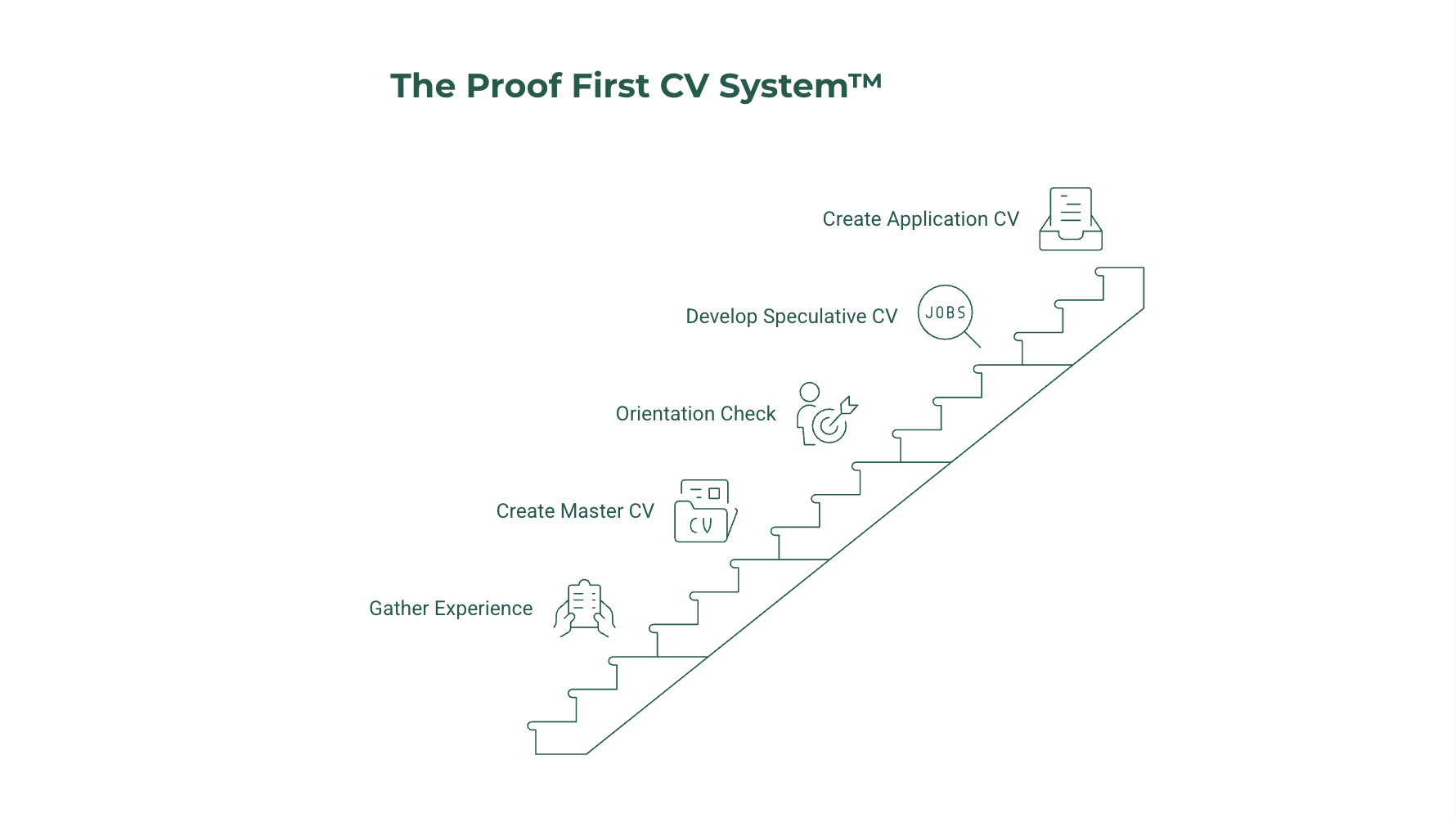
Do not skip the orientation check. Do you have enough clarity?
The CV You Need When Applying for Roles
Once you target a specific role, the expectation changes completely.
Recruiters are no longer asking:
“Who are you becoming, and how can I help?”
They are asking:
“Can you do this job?”
An application CV focuses tightly on relevance:
matching experience to requirements
translating your background into the terms and language of the role
selecting proof aligned to the role
demonstrating outcomes clearly
Importantly, this should not mean rewriting your CV from scratch every time.
The strongest candidates adapt from an existing foundation rather than reinventing their story repeatedly.
Critically though, this is not an iteration of your last version. If you evolve from a your last CV, then you carry the weight of whatever relevant experiences you had for the previous role.
Instead, your Application CV should be a ground up construction based on the translation of your career to date into the terms and language of the role.
Pulling from your Master Career Database.
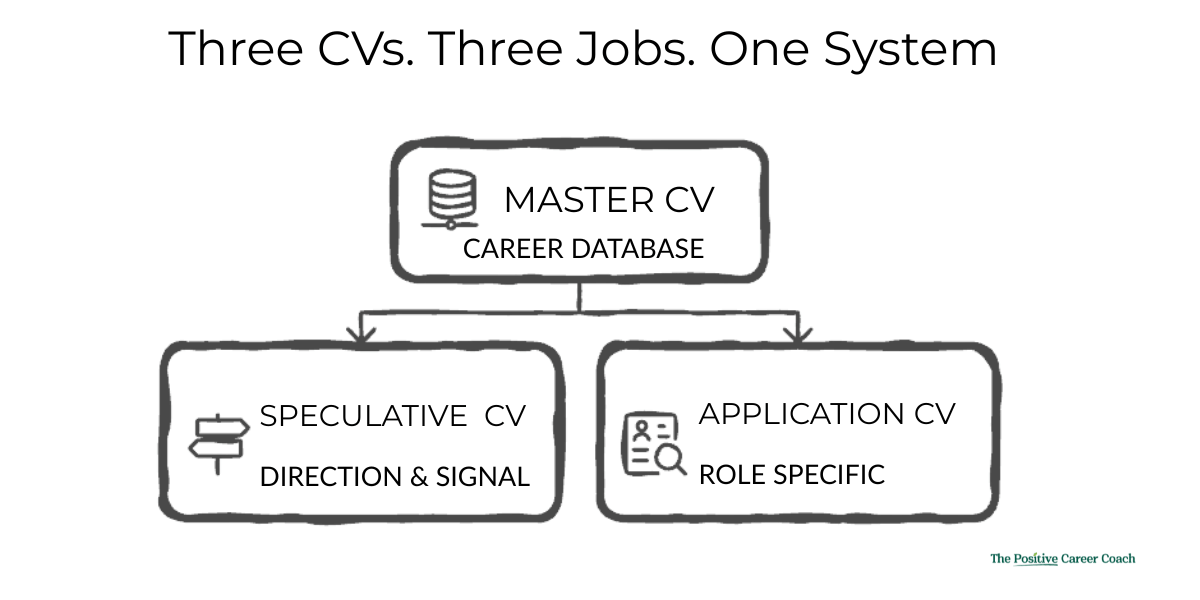
The Proof First CV System™
For more about how to create the system that makes this process easy check out The Proof First Resume System™
The Biggest Career Change Mistake I See
Many professionals jump straight to application-style CVs too early.
They tailor endlessly before they have clarity on direction.
This creates two problems:
networking conversations feel awkward or overly narrow
applications feel exhausting because positioning keeps shifting
Ironically, this often leads people to believe their experience isn’t transferable — when the real issue is timing.
How to Know Which CV You Need Right Now
Ask yourself one question:
Am I exploring possibilities, or pursuing a defined role?
If you are:
speaking to new contacts
testing industries
asking for introductions
learning how your skills translate
→ you need a conversation-focused Speculative CV.
If you are:
applying to advertised roles
working with recruiters
responding to job descriptions
→ you need a tailored Application CV.
Most career transitions require both — just not at the same time.
READ NEXT: How AI agents are the smart tools for your career shift - but don’t use them like everyone else
Why This Distinction Makes Career Change Easier
Once people separate these two purposes, something shifts.
Networking becomes easier because you are no longer pretending certainty.
Applications become faster because you are selecting relevant examples instead of rewriting everything.
And confidence improves because your CV finally matches the stage you are actually in.
A Simpler Way to Build Both
This distinction sits inside the broader approach of the The Proof First Resume System™ — separating the Master CV (your evidence base), the speculative CV, and the application CV.
If you want to see how the full structure works together, you can read the guide here:
👉 [The Proof First CV System: How to Write a CV for a Career Change]
Because during a career transition, the problem usually isn’t your experience.
It’s using the wrong document for the moment you’re in.
Frequently Asked Questions About Mid-Career Resume Writing
-
Many professionals optimise too early. Without clarity on direction, each version tries to solve a different problem, which creates confusion for readers and exhaustion for you.
Clarity first.
-
Send a broader, conversation-focused CV that explains what you’ve done and the direction you are exploring.
Ideally with an opening paragraph that maps to the phrase "I want to help X do Y, so they get Z”
During networking conversations, people are trying to understand where you might fit, not assess you against a job description.
-
Yes — but tailoring should come from selecting relevant experience, not rewriting everything from scratch. A strong application CV adapts evidence from a core foundation rather than reinventing your story each time.
Which requires you have a well developed sense of the niche you are aiming for. (If you don’t have that, then maybe take a step back and develop your direction first)
-
Usually not. A networking CV helps others understand your transferable skills and future direction, while an application CV proves suitability for a specific role. Mixing the two often makes your positioning unclear.
-
That’s common during career change. If writing a clear direction statement feels difficult, you may still be in an exploration phase. In that case, focus first on clarifying interests and criteria before heavily tailoring a CV.
-
The terms are largely interchangeable. “CV” is more common in the UK and Europe, while “resume” is used in the US. In both cases, the goal is the same: clearly communicate relevant experience and direction to the reader.
-
art tailoring once you are pursuing clearly defined roles. Before that point, a broader conversation-focused CV is usually more effective for testing direction and building opportunities.