Burnout or Career Misalignment? - Why You Feel Stuck at Work
Feeling disengaged at work isn’t always burnout
Many professionals searching for help with burnout, career dissatisfaction, or feeling stuck at work assume exhaustion is the problem. But for a large number of mid-career professionals, the issue isn’t burnout at all.
They are still capable, productive, and functioning well — yet increasingly disengaged from work that once felt meaningful.
If you’ve found yourself questioning your motivation, struggling to stay engaged, or trying to survive a role you can’t easily leave yet, rest alone may not solve it. Often the real issue is not depletion, but direction.
Understanding the difference between burnout and career misalignment is the first step toward regaining energy — without making dramatic or risky career decisions.
If you’re currently trying to survive a job you can’t leave yet, this article builds on that conversation by exploring why disengagement happens in the first place. And, once you know the cause, what you can do about it.
Why burnout has become the default explanation for career dissatisfaction
Burnout dominates modern career conversations.
It’s familiar language. Socially acceptable. Easy to explain.
Saying “I’m burnt out” feels safer than saying “this work no longer feels meaningful.”
Burnout suggests recovery.
Misalignment suggests change.
And change — particularly mid-career — feels far more unsettling.
Many of the professionals I speak with aren’t exhausted across their whole lives. They still exercise. They engage socially. They can become animated discussing ideas outside work.
The fatigue appears in one place only. Yup - “the Monday afternoon staring at the calendar for the week ahead”
That’s usually a clue.
Burnout vs misalignment — how to tell the difference
The two experiences can look similar on the surface but behave very differently.
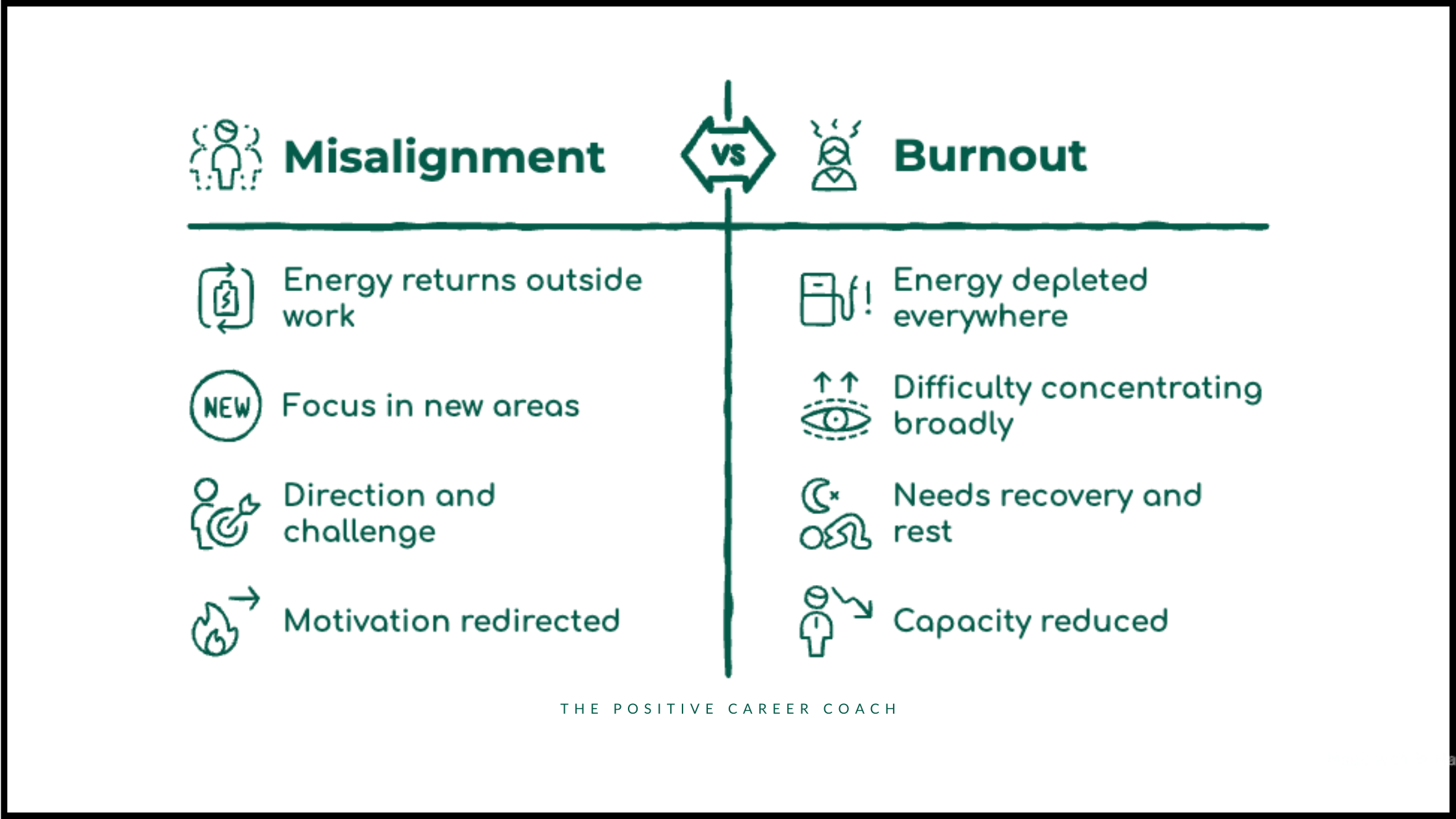
The significant difference in symptons. Which side resonants most?
Burnout removes energy.
Misalignment redirects it.
Many high performers aren’t running out of fuel — they’re simply no longer motivated by the destination.
To be clear, both are shit and both deserve attention and correction, but exactly what kind of correction depends on which it is.
The competence trap — why successful people feel stuck at work
Here’s the paradox that trips many people up, because whilst it is obvious, it is also profound and unspoken.
The better you become at something, the more valuable you are doing it.
Organisations reward reliability. Promotions follow competence. Responsibility increases. Psychologists sometimes refer to this dynamic through the Peter Principle — people advance because they perform well in their current role, not necessarily because the next stage remains motivating or aligned. ( L. Peter and R.Hull 1969)
Gradually, you become known for solving problems you no longer find interesting.
Success quietly locks you in place. You might recognise this experience, of looking at your boss, or boss’s boss and knowing you don’t want that job, but are on a ladder straight to it.
Behavioural research calls this hedonic adaptation: achievements that once felt exciting quickly become normal. The promotion you worked toward soon feels like baseline expectation rather than progress.
Leaving then begins to feel irrational. You are trusted, experienced, and well compensated. Years of investment create a powerful pull to stay — a version of what behavioural economists describe as sunk cost bias.
In their work on Self-Determination Theory (R.M. Ryan and E.L. Deci - 2000), long-term motivation depends not just on competence, but also autonomy and purpose. Mid-career professionals often retain mastery while losing connection to why the work matters to them.
Many people stay not because they love the work, but because they are exceptionally good at it.
The mid-career identity shift most people miss
Early careers revolve around performance.
Can I succeed?
Can I prove myself?
Can I progress?
Mid-career introduces a different question:
Do I want to spend my energy on this problem?
Achievement alone stops being enough. Contribution starts to matter more.
When this identity shift happens, roles designed around performance rather than purpose begin to feel strangely hollow — even when they continue to look successful from the outside.
What actually helps when you can’t leave your job yet
This is where many people make things harder than necessary.
They assume clarity must come before movement.
So they think. Analyse. Research endlessly. Wait for certainty.
But clarity rarely arrives through thinking alone.
One of the early principles of the Positive Career Method™ is simple:
Exploration comes before decision.
You don’t figure out your next step by choosing — you figure it out by testing.
Instead of asking, “What should I do next?” a more useful question is, “How will I know when I’ve found what I’m looking for” and then “What could I explore next?”
A simple four-week experiment to regain motivation at work
Rather than planning a career change, try running a small experiment.
Design something over the next four weeks that meets three criteria:
1. It introduces new people
Engage with perspectives outside your usual professional environment.
READ NEXT : The importance of perspective and how to manage yours
2. It produces something tangible
A short piece of work, analysis, contribution, or collaboration you can complete. A real actual ‘deliverable’ not just you thinking about something.
3. It is discrete and time-bound
No dramatic commitments. Something achievable alongside your current role.
This might look like:
turning up and contributing to a local sustainability meet-up
researching and sharing insight on a topic you care about
collaborating on a small project outside your normal remit
The goal is not reinvention.
The goal is information — discovering where energy returns.
Why experimentation works better than immediate career change
Action reduces uncertainty faster than analysis.
Small experiments allow you to:
test interest without risk
reconnect effort with meaning
build evidence before making decisions
Most importantly, they shift you out of inertia.
Action Beats Analysis. Every-time.
Career transitions rarely begin with bold leaps. They begin with quiet exploration.
Why impact and climate work often appear at this stage
Many professionals rediscover motivation when applying their experience to problems that feel consequential — sustainability, climate, or broader impact work.
Not because these paths are fashionable, but because they offer complex challenges where experienced judgement matters.
The shift isn’t about abandoning your career.
It’s about redirecting it toward problems that feel worth solving.
A different way forward
If you feel disengaged but not exhausted, burnout may not be the full story.
You may simply have outgrown the work you’re doing.
The answer isn’t necessarily rest — and it isn’t immediate resignation either.
It’s exploration.
So consider this:
What could you involve yourself in over the next four weeks that introduces new perspectives, creates something tangible, and helps you test where your energy actually returns?
If you’d like help designing that exploration, this is exactly the work I do with clients — helping experienced professionals move from confusion to clarity through structured experimentation.

Frequently Asked Questions
-
Burnout usually affects energy across all areas of life — work, relationships, and personal activities. Disengagement tends to be selective. If your energy returns quickly outside work or when exploring new ideas, the issue may be misalignment rather than exhaustion. Many professionals mistake loss of meaning for burnout because the symptoms initially feel similar.
-
Yes. Many high performers feel stuck not because they lack capacity, but because they have outgrown the problems they are solving. When skills continue to be used but motivation fades, work can feel draining even though performance remains strong. This often signals a need for direction rather than recovery.
-
Instead of rushing into a career change, start with small experiments alongside your current role. Speak to new people, explore adjacent fields, or contribute to short projects that create tangible outcomes. Exploration helps restore clarity and momentum without requiring immediate risk. The most important thing is ACTION, not analysis. So set specific 2-4 week sprints of experimentation.
-
No. Most career transitions involve redirecting existing experience rather than abandoning it. Skills built over years often become more valuable when applied to new problems or sectors. The goal is usually alignment, not reinvention.